Yes, if your display lightbox uses LED strips or modules specified for a fixed DC input voltage: it needs a constant-voltage driver with that same output voltage and enough permitted output capacity. A lightbox with a current-rated LED chain instead needs a compatible constant-current driver. Display lightboxes do not all require the same type, and matching wattage alone is not enough.
This guide covers fabric-faced SEG walls in the LED lightbox displays range. Confirm the choice from the manual, driver label, and wiring diagram for your exact model. Frame dimensions, connector shape, and the appearance of the fabric face cannot establish electrical compatibility.
Safety first for this driver check
Keep owner checks external. Do not open drivers, probe circuits, rewire LED sections, or swap driver types for a trial. If you notice a burning smell, scorching, melted plastic, damaged wiring, unusual heat, or repeated breaker tripping, stop using the display. Disconnect it only if safe to do so, and have qualified personnel assess it.
In covered U.S. workplaces, listed or labeled equipment must be installed and used according to the instructions included in its listing or labeling.[1] OSHA generally requires exposed live parts to be deenergized before work, subject to specified exceptions; work on equipment that has not been deenergized is restricted to qualified persons.[2] These are U.S. workplace requirements, not a substitute for local electrical rules or venue instructions.
Constant-voltage versus constant-current
The distinction is what the driver regulates at its output. Match that behavior to the LED assembly’s documented input requirements, rather than choosing from the power rating alone.
| Driver type | What it regulates | Compatible LED arrangement | What must match |
|---|---|---|---|
| Constant-voltage | Output voltage | Strips or modules designed for a fixed-voltage supply, with current limiting or regulation in the assembly | Fixed input voltage of the LED sections, total load within driver rating, dimming type |
| Constant-current | Output current | A current-rated LED chain designed to rely on the driver for current regulation | Rated current of the chain, driver’s output-voltage range covering the chain, dimming type |
When constant-voltage fits a SEG lightbox
A constant-voltage supply fits when the LED sections are specified for the same fixed DC voltage and their combined load stays within the supply’s permitted output under the installation conditions. Parallel sections can share a supply only as allowed by the manufacturer’s wiring plan. Parallel wiring by itself is not proof that a module is designed for constant-voltage operation.
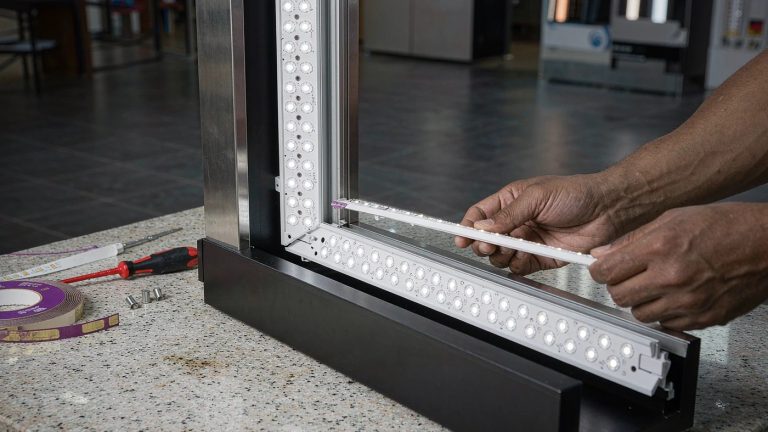
Milin’s SEG Fabric LED Lightbox catalog describes strips fitted into frame channels, with 300 × 240, 450 × 240, and 600 × 240 cm options, a 12 cm aluminum profile, and 2.0 mm wall thickness. Those are construction specifications, not driver ratings. The catalog information establishes neither a particular output voltage nor the correct driver for an individual wall.
When the answer is no
If the LED engine is specified to receive a regulated current from its driver, use a matching constant-current model. Its output current must suit the LED chain, and its operating output-voltage range must accommodate the chain’s forward voltage across the specified operating conditions. Do not infer the driver type merely because LEDs are connected in series inside a module; use the input specification of the complete LED assembly.
How to confirm your driver type
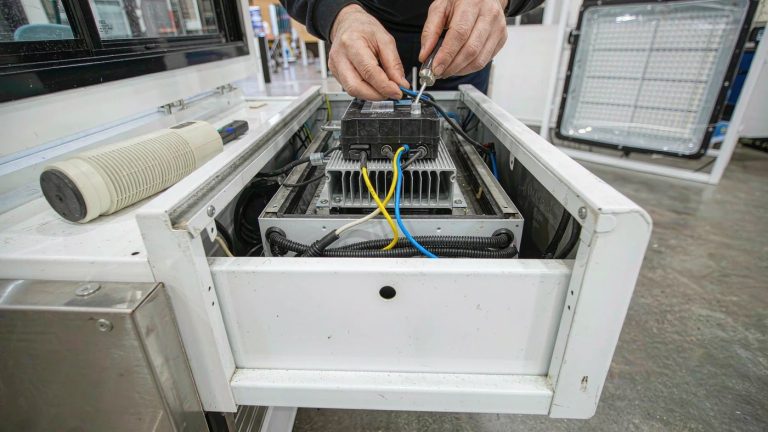
Collect three items to answer the driver question for your wall: a photo of the driver label, the product manual, and the wiring diagram. Do not open an energized frame or probe circuits to obtain them.
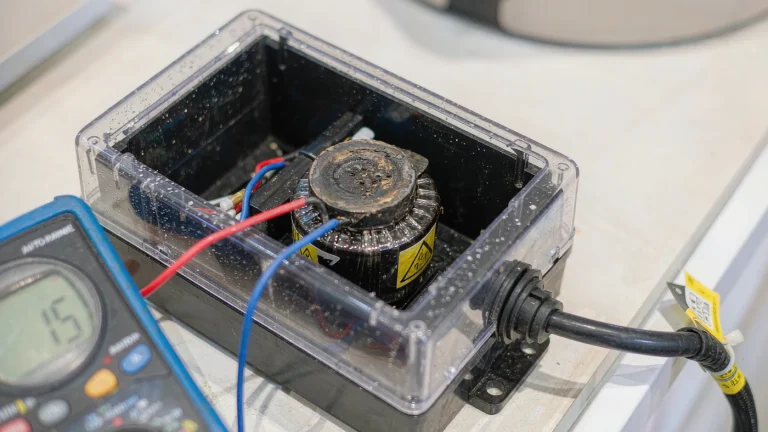
- Photograph the complete, externally accessible driver label. Read the DC output specification, not just the AC input. Look for a fixed output voltage with current or power limits, or a regulated output current with an operating voltage range.
- Compare that label with the manual and wiring diagram. Confirm the driver type, LED sections assigned to each supply, and any dimming requirements. Do not assume an existing replacement is correct merely because it is already installed.
- Find the LED assembly’s input requirements in the manual or supplier documentation. If obtaining markings would require opening the frame or accessing wiring, leave that inspection to qualified personnel.
- Give the supplier one packet when you order: original part number, output ratings, driver type, control type, section count per supply, destination market, and the standards evidence required for that market.
If documents are missing, unreadable, or inconsistent, stop the selection and use the contact page to request model-specific confirmation. Include the order identifier and available label photos. Check the after-sales policy for the applicable support terms; it is not an electrical compatibility certificate.
A practical check before expanding a wall
Consider a hypothetical owner moving an existing wall into a larger custom booth. The original manual confirms constant-voltage operation, but the owner wants to add another illuminated section. That does not automatically change the required driver type. It changes the proposed load and may change the approved wiring arrangement, so the original supply may no longer be suitable.
Before ordering, send the supplier the original wiring plan and a proposed layout identifying the sections assigned to each supply. Ask for confirmation of the revised load, permitted wiring, and control compatibility. If the layout is unclear, ask which photos qualified personnel should provide rather than opening the wall yourself. This is a planning scenario, not a report of a customer installation or a field test.
Match the full specification
A yes to constant-voltage still needs all six items matched:
- Driver type: constant-voltage or constant-current, as specified for the LED arrangement.
- Output ratings: fixed voltage and permitted load for constant-voltage; rated current and output-voltage range for constant-current. Compare ratings stated under identical conditions, including temperature limits, load tolerances, and dimming state, using the label and the manual. Do not compare AC input consumption with DC output capacity.
- Load assignment: the number of LED sections connected to that supply in the approved layout. Adding or moving a panel requires a new permitted-load check.
- Dimming and controls: match the driver’s documented control interface and the approved dimmer or timer arrangement. Do not assume a supply is dimmable because another driver of the same wattage is.
- Protections and market approvals: confirm the exact part’s protection functions and the evidence required for the destination. UL 8750 covers LED equipment for use in lighting products.[3] IEC 61347-1:2024 addresses general safety requirements for controlgear for electric light sources.[4] IEC 61347-2-13:2024 addresses particular safety requirements for electronic controlgear for LED light sources.[5] Naming these standards does not certify a supply or a complete display. Ask the supplier to confirm the applicable editions and product-specific evidence.
- Input supply: the venue voltage and circuit arrangement must match the driver input requirements. Wiring methods, components, and equipment for general use have separate installation requirements.[6] Exhibitors must not open distribution equipment or modify plugs to force compatibility. Assessment of venue power remains with the venue electrician.
A load calculation is not a compatibility approval
For a hypothetical constant-voltage layout, assume two sections each draw a specified 60 W at the required voltage. Their combined load is 60 + 60 = 120 W. Against a candidate supply rated for 150 W of continuous DC output at that same voltage, nominal loading is 120 ÷ 150 × 100 = 80%. This assumes the stated ratings apply to the operating conditions and excludes any additional load.
The calculation does not establish that the supply is suitable. Temperature derating, load tolerances, controls, and installation requirements still need checking. An 80% result is not a universal design rule or a recommended spare-capacity margin.
What goes wrong with the wrong type
Either mismatch direction can produce similar symptoms. Symptom patterns alone do not identify the fault, because wiring faults, control faults, protection shutdowns, and LED faults can look similar. Record the pattern for the technician:
- A chain designed to rely on its driver for current regulation can receive excessive current from an unsuitable constant-voltage supply, potentially damaging the LEDs.
- A fixed-voltage strip connected to an unsuitable constant-current driver can operate outside its intended voltage conditions. Depending on the combination, it may show uneven light, flicker, fail to light, enter protection, or suffer damage.
An incompatible dimmer can also cause flicker or a limited dimming range. Give the technician the fault pattern, driver-label photos, and the layout showing any added or moved sections. For a multi-zone experience center display, identify which sections share a supply rather than reporting only the overall wall dimensions.
Quick answers
Does a larger lightbox need a different driver type?
Not simply because it is larger. The LED assembly’s input requirements determine the type; its load and approved grouping determine the required capacity and number of supplies. A larger frame alone cannot tell you either.
Can I replace a constant-current driver with a constant-voltage driver of the same wattage?
No. Equal wattage does not make the two driver types interchangeable. A change in regulated behavior requires a supplier-approved redesign.
Will a larger-wattage driver of the same type fix dim or uneven light?
A higher-wattage driver of the same type helps only when insufficient output capacity caused the problem, and when the replacement matches all other requirements and has approval for the installation. Additional wattage does not correct incorrect voltage, incorrect current, damaged wiring, or an unsuitable installation.
Can I mix LED sections from different walls on one driver?
Only when the supplier confirms the combination and wiring plan are compatible. Matching connectors do not prove matching electrical requirements. In an illuminated product display with shelving, the shelves themselves do not add electrical load; added or changed lighting can. Include any such changes in the compatibility review.
Bottom line
When the manual and the label agree on a fixed-voltage system, order that driver type with all six items matched: type, ratings, load assignment, controls, approvals, and input supply. When the documents describe a current-rated series chain, order the corresponding constant-current type on the same basis.
Unsure which driver type your lightbox needs?
Send the driver label, manual pages, and section count per supply for a compatibility check before you order.
References
- OSHA, 29 CFR 1910.303, General requirements for electrical installations: https://www.osha.gov/laws-regs/regulations/standardnumber/1910/1910.303
- OSHA, 29 CFR 1910.333, Selection and use of work practices for electrical safety: https://www.osha.gov/laws-regs/regulations/standardnumber/1910/1910.333
- UL 8750, Light Emitting Diode (LED) Equipment for Use in Lighting Products: https://www.shopulstandards.com/ProductDetail.aspx?UniqueKey=30052
- IEC 61347-1:2024, Controlgear for electric light sources — Safety — Part 1: General requirements: https://webstore.iec.ch/en/publication/64758
- IEC 61347-2-13:2024, Controlgear for electric light sources — Safety — Part 2-13: Particular requirements — Electronic controlgear for LED light sources: https://webstore.iec.ch/en/publication/64713
- OSHA, 29 CFR 1910.305, Wiring methods, components, and equipment for general use: https://www.osha.gov/laws-regs/regulations/standardnumber/1910/1910.305