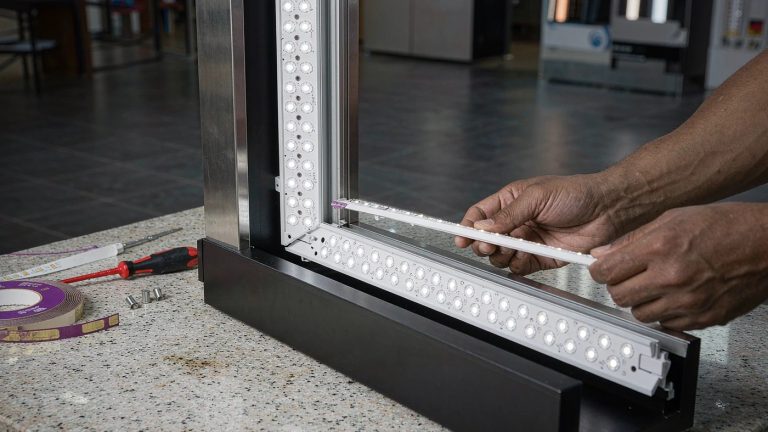
Neutral-to-daylight white is a sensible starting choice for backlit fabric graphics, but the right LED color temperature is the one approved with your printed fabric in the actual lightbox. If a supplier offers 6,000–6,500 K LEDs, treat them as a candidate to proof, not a guarantee of accurate brand colors. Consider a warmer option for a deliberately warm setting, and match adjacent lightboxes to the same approved specification.
This advice applies to SEG lightboxes and backlit fabric used in trade show booth systems and retail displays. Before ordering, ask for the available color temperatures, color-rendering data, and a lit sample. A Kelvin number alone cannot approve the artwork.
What Kelvin tells you about a fabric lightbox
Correlated color temperature, or CCT, describes the warm-to-cool appearance of a light source. Lower values look warmer; higher values look cooler. NIST gives approximately 2,800 K as a warm incandescent-like example and 9,000 K as a bluish-white example. These are appearance reference points, not recommended lightbox settings. [1]
CCT does not tell you how bright a lightbox will be or prove how accurately it will reproduce a printed logo. The U.S. Department of Energy describes color rendering separately through CRI and warns that a large CCT change, such as 2,700 K to 4,100 K, is noticeable. Its guidance concerns general lighting, not a fabric-lightbox specification. [2]
A warmer backlight may make a white area look creamier, but avoid rules such as “all blues turn green” or “cooler light preserves every brand color.” Check the actual print rather than predicting individual ink colors from Kelvin alone.
Which color temperature should you compare
| Display situation | Candidate to request | What to approve |
|---|---|---|
| Brand-led trade show backwall or SEG lightbox | The supplier’s neutral or daylight-white options; include 6,000–6,500 K if offered | The actual logo, white areas, grays, and skin tones on illuminated production fabric |
| Retail promotion under warm store lighting | A neutral option and a warmer alternative available for that lightbox | The graphic both by itself and beside the surrounding merchandise and lighting |
| Lounge, hospitality, or mood-led display | A warm-white option, with artwork proofed for that light source | Whether the desired atmosphere is worth any change in whites or brand colors |
| Several adjacent lightboxes or an expanding booth | The approved specification used for the existing display, where available | A side-by-side comparison of the old and new units, not just matching datasheet labels |
These are comparison choices, not standardized Kelvin requirements. No universal 6,000–6,500 K requirement for fabric graphics is established by the sources cited here. Do not assume that Milin supplies a particular CCT, CRI, or module tolerance without a quotation or product datasheet confirming it.
Why a daylight label is not color approval
A cooler white can suit the visual direction of a bright exhibition backwall. That is a design decision, not proof that it produces the smallest color error. For critical brand work, select the light source and print process together rather than choosing a Kelvin number first and expecting every artwork file to fit it.
ISO 3664:2025 addresses viewing conditions for critical evaluation and comparison of graphic materials, including backlighted signs. Its scope supports a controlled evaluation process; it does not establish 6,000–6,500 K as the required LED setting for every fabric lightbox. Ask the print provider which viewing conditions and reference it will use for approval. [3]
Check color rendering and light uniformity separately
The data behind the white-light label
Request CCT and CRI for the proposed LED module, plus any stated CCT tolerance and batch information. DOE’s general-lamp purchasing guidance describes CRI on a 0-to-100 scale and cites 80 as a minimum for ENERGY STAR-qualified bulbs. That is a general-lamp reference, not a guarantee that CRI 80 will satisfy a particular fabric graphic. [2]
If the artwork contains difficult brand reds or skin tones, ask whether a higher-color-rendering option is available. Compare it with the proposed standard module using the same printed sample. Do not buy a higher rating without checking whether it improves the graphic you need to display.
Hotspots and dark corners
Inspect uniformity independently of color temperature. If the sample has visible LED dots or dark corners, ask the supplier to check module layout, diffusion, fabric, and frame depth. A different Kelvin label is not evidence that these faults have been corrected. Evaluate them in the proposed LED lightbox display, not only on a loose illuminated swatch.
Approve a lit proof before the production run
A useful proof should answer a practical question: will this artwork work with this fabric, print process, and lightbox? The following approval procedure is buying guidance, not a report of Milin testing or a customer project.
A brand logo on a mostly white backwall
For this scenario, request a sample containing the logo, a white area, neutral grays, and any important photographic colors. Use the proposed production fabric and ink process. View it in the specified lightbox with the proposed LEDs. An unlit swatch can help check print detail, but it should not be the sole approval for a backlit graphic.
If two LED options are available, compare the same print under each option before changing the artwork. Otherwise, a changed print and a changed light source leave you unable to tell which adjustment helped. Record the selected combination rather than approving “daylight white” without a module reference.
A display beside warm store lighting
First inspect the sample with its backlight on and nearby lighting minimized where practical. Then inspect it with the surrounding store lights on. The first check helps isolate the lightbox; the second tests the display environment. Ask the person responsible for brand approval to accept the result under the conditions that matter for the installation.
Use the intended operating brightness. If dimming is part of the specification, inspect the actual driver and module combination at the settings you expect to use. Record those settings with the proof. Identical dimmer percentages on different systems are not an acceptance test for matching appearance.
A record that makes the next order repeatable
Keep the approved physical proof and record the artwork version, fabric, print process, LED model, nominal CCT, stated CRI, driver, dimmer setting, and approval date. Ask the supplier to identify any unavailable information before the production order. This creates a reference for reprints without inventing a numerical color tolerance.
Match old and new lightboxes before replacing parts
When adding a panel to an existing tension fabric display, start with the existing module specification and approved proof. DOE advises choosing similar CCTs when replacing light sources; use that as a starting check rather than assuming the same nominal Kelvin label guarantees a match. [2]
Place an old and new unit side by side at the intended brightness before accepting the addition. If the appearance differs, check the light source, fabric, print, and operating settings before replacing modules or altering artwork. Do not automatically relamp a serviceable display, and do not use an artwork correction to conceal an unidentified lighting mismatch.
Read the datasheet and confirm the safety scope
The FTC’s consumer Lighting Facts label includes light appearance, brightness, energy use, and other information for light bulbs. It is a useful reminder to request actual specifications, but a bulb-packaging label is not a certification or performance report for a fabric lightbox. [4]
For U.S. projects, UL’s Commercial Displays guide describes UL 48 as covering electric signs, including LED illumination, for use in accordance with NEC NFPA 70. This is scope guidance, not evidence that a particular display is listed or that a particular code edition applies at your venue. [5]
OSHA explains that recognized testing laboratories use registered certification marks to designate product conformance. Ask for the applicable mark and documentation for the specified product; do not infer complete-lightbox certification from a certified component alone. [6]
- Have the supplier confirm the LED and driver combination, voltage, load, and enclosure suitability against the product documentation.
- Check heat management. DOE warns that enclosed fixtures can trap heat and affect the performance and life of certain LED products. [2]
- Leave mains wiring, electrical modifications, and the structural installation of hanging signs to qualified personnel following local and venue rules. Obtain venue approval where required.
What to put in the lightbox order
Specify the approved LED model and CCT, color-rendering data, print-and-fabric combination, operating setting, and physical proof reference. If 6,000–6,500 K is the option that passes your approval, order that confirmed configuration. If a warmer option works better in the intended setting, approve the artwork under that option instead.
For a new backwall design or a multi-unit rollout, send the artwork, planned lighting conditions, and any existing module details through the contact form. The useful answer is a repeatable, approved display configuration, not a Kelvin number without a proof.
Unsure which CCT your artwork was built for?
Send your graphic file and booth plan. Milin will confirm the white tone, CRI baseline, and proofing steps before you print.
References
- Y. Ohno, NIST, CIE Fundamentals for Color Measurements (2000). CCT definition and warm/cool examples. Accessed November 12, 2026.
- U.S. Department of Energy, FEMP, Purchasing Energy-Efficient Light Bulbs. General-lamp CCT, CRI, replacement, and enclosure guidance; acquisition guidance updated June 2023. Accessed November 12, 2026.
- ISO, ISO 3664:2025, Graphic technology and photography — Viewing conditions, fourth edition, July 2025. Catalog scope includes critical evaluation of backlighted signs. Accessed November 12, 2026.
- U.S. Federal Trade Commission, Shopping for Light Bulbs (May 7, 2021). Lighting Facts label information for light bulbs. Accessed November 12, 2026.
- UL Solutions Code Authorities, Commercial Displays (October 31, 2017). UL 48 scope guidance, not a current venue-code determination. Accessed November 12, 2026.
- OSHA, Nationally Recognized Testing Laboratory Program. Recognition and certification-mark information. Accessed November 12, 2026.