A modular exhibition stand is a practical choice for companies that attend several trade shows, use a repeatable range of booth sizes, and want to reuse the same main structure. It can reduce repeated production, make costs easier to plan, simplify repairs, and keep the brand consistent across different countries.
It is not automatically cheaper than a custom booth. The result depends on how many times the system is reused, how much inventory is needed for each layout, how efficiently it packs, and how much the company spends on freight, storage, graphics, labor, and repairs.
Before buying, compare the system over three to five years rather than judging it by the first-event price.
What Is a Modular Exhibition Stand?
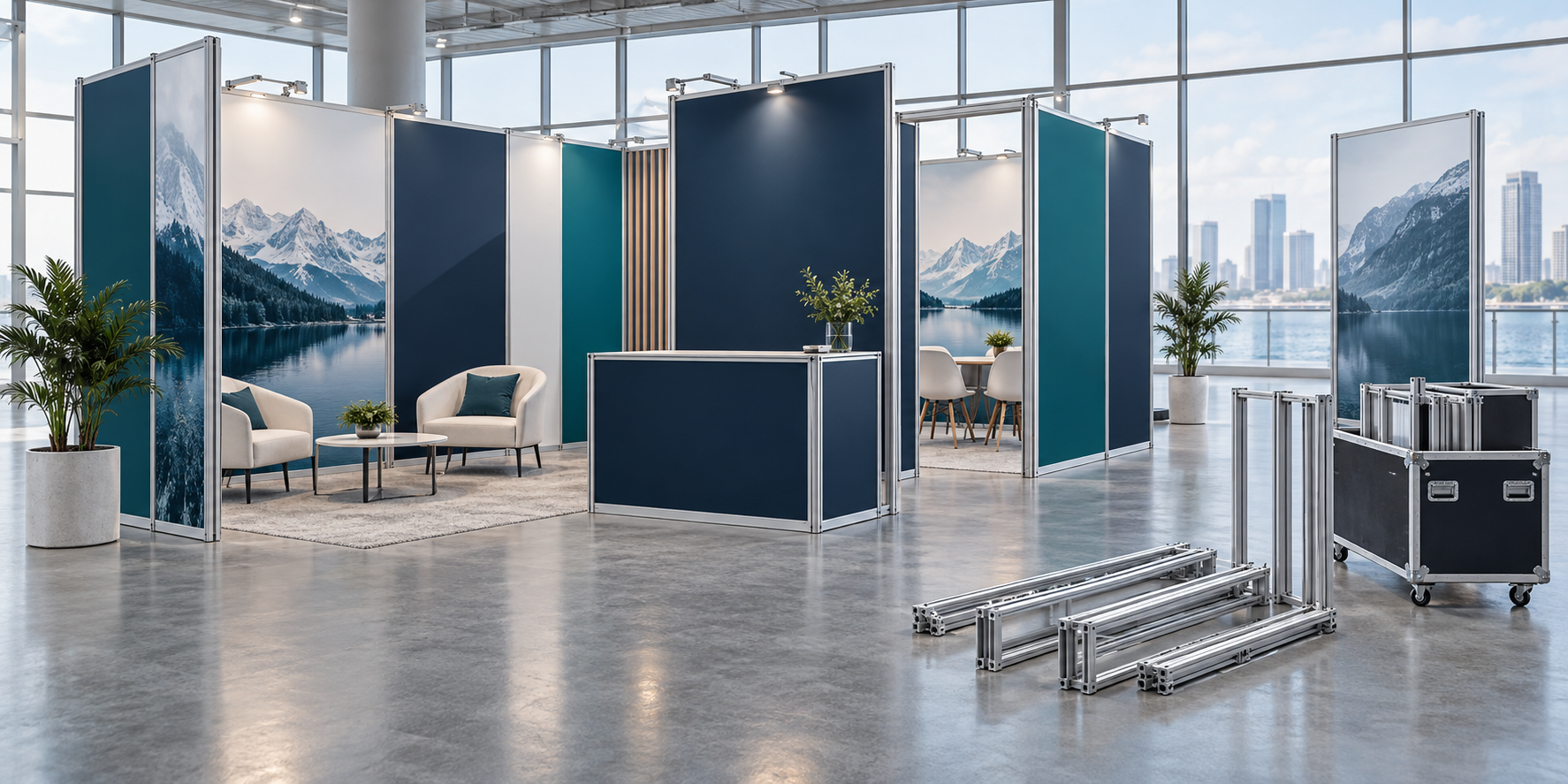
A modular exhibition stand is built from standard parts that can be connected in different ways. Common components include aluminum frames, fabric graphics, wall panels, counters, shelves, lightboxes, doors, storage rooms, screen mounts, lighting, and hanging signs.
The same inventory may be arranged for several booth sizes:
| Example booth | Dimensions | Floor area | Possible setup |
|---|---|---|---|
| Small in-line booth | 3 × 3 m | 9 m² | Back wall, counter, screen, and one product area |
| Medium corner booth | 3 × 6 m | 18 m² | Two open sides, reception, products, and small storage |
| Island booth | 6 × 6 m | 36 m² | Four open sides, demonstrations, meetings, and storage |
These are planning examples, not fixed booth standards. Actual sizes and open-side rules depend on the event.
Modular does not mean every booth must look the same. The hidden frame can remain unchanged while the company replaces the visible parts, such as:
- Printed graphics
- Product displays
- Reception counters
- Lighting
- Video screens
- Meeting furniture
- Local-language messages
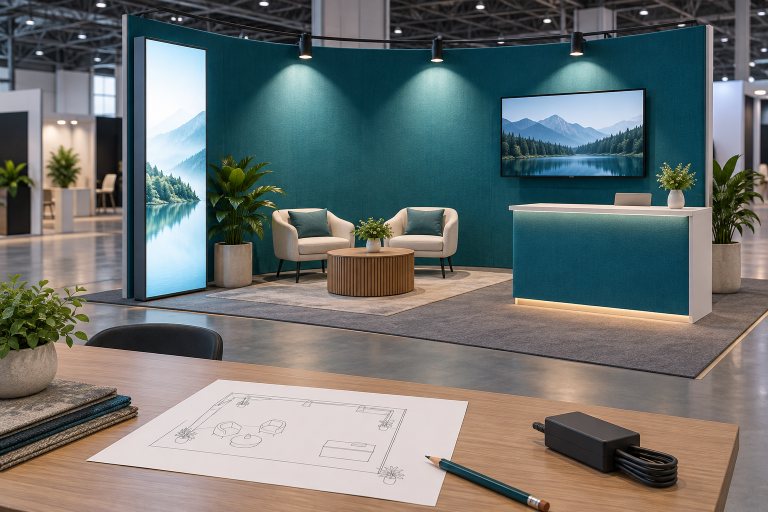
A lightweight tension fabric backdrop booth may be enough for a simple back wall. A stronger aluminum exhibition booth may be more suitable when the design includes several walls, shelves, counters, rooms, or connected display areas.
The best system is not the one with the most parts. It is the one that can create the layouts the company will actually use.
When Does a Modular Stand Make Sense?
A modular stand is usually worth considering when:
- The company attends several exhibitions each year.
- Most booth sizes fall within a planned range.
- The main brand design will remain stable for several years.
- Similar product, meeting, demonstration, and storage areas are needed at different events.
- The company has a storage and maintenance plan.
- One person or team is responsible for the inventory.
It may be less suitable when:
- The company is attending only one event.
- Every show needs a completely different structure.
- The booth must support unusually heavy machinery.
- The brand is about to be redesigned.
- The future exhibition schedule is uncertain.
- International freight and storage cost more than local rental.
The number of events alone is not enough. A company may attend ten shows but reuse little because every booth is different. Another company may attend four shows and reuse nearly the whole structure.
Compare the Full Cost
A modular stand may cost more at the first event because the first order can include frames, graphics, lighting, counters, cases, engineering, spare parts, and a full test build.
The saving comes from later reuse. A fair comparison should include the same cost items for both modular and one-time booths.
| Cost group | Items to include |
|---|---|
| Initial cost | Structure, walls, counters, lights, graphics, engineering, design, cases, spare parts, and test assembly |
| Event cost | Freight, customs, installation, dismantling, new graphics, furniture, electricity, internet, cleaning, and venue services |
| Ownership cost | Storage, insurance, inspections, repairs, replacement parts, upgrades, and disposal |
Do not compare a custom-booth quotation that includes freight and installation with a modular-system price that excludes them. Both options must cover the same work.
A simple break-even formula is:
Break-even reuse count = Extra upfront cost ÷ Saving per later event
For example, assume a modular system costs $35,000 more than a one-time booth but saves $9,000 during each later use:
$35,000 ÷ $9,000 = 3.89
The extra investment would be recovered during the fourth reuse, or around the fifth event in total.
The following three-year example includes storage and repair costs instead of comparing structure prices alone:
| Cost item | One-time custom booths | Modular system |
|---|---|---|
| First event | $30,000 | $65,000 |
| Five later events | $150,000 | $45,000 |
| Three-year storage | Not applicable | $9,000 |
| Repairs and replacement parts | Included in each new build | $6,000 |
| Total | $180,000 | $125,000 |
Under these assumptions, the modular option saves $55,000 over six events, or about 30.6% of the custom-booth total.
This is a sample calculation, not an industry price benchmark. Real costs depend on booth size, location, labor, materials, freight, storage, graphic changes, and damage.
Prepare at least three budget versions:
- Best case: booth sizes repeat, damage is low, and only a few graphics change.
- Expected case: some parts and graphics change, with normal storage and repair costs.
- High-cost case: freight is expensive, layouts change often, or several parts need replacement.
If the purchase only saves money in the best case, it may be too risky.
Measure How Much Inventory Is Reused
A system is not truly efficient just because it can be rearranged. The company must check how many owned parts are used in each layout.
For example, assume a system contains 100 structural parts:
- The 9 m² booth uses 42 parts.
- The 18 m² booth uses 70 parts.
- The 36 m² booth uses 94 parts.
The reuse rates are 42%, 70%, and 94%. During the 9 m² event, the company must still store and maintain the remaining 58 parts.
As an internal planning target, a buyer may ask whether at least 70% of the owned structural inventory can be used across its three most common booth layouts. This is not an industry rule. It is a practical test that helps identify systems with too much unused equipment.
For every proposed layout, ask the supplier to show:
- Parts used
- Parts left in storage
- New parts required
- Graphics that must be replaced
- Packed weight and volume
- Installation crew and labor hours
A supplier may present five attractive layouts even though each version requires a large new purchase. The useful figure is the percentage of the existing inventory that can be reused.
Plan the Booth Around Visitors
Do not start with walls and counters. Start by deciding what visitors should see and do.
A practical booth may need areas for:
- Seeing the brand from the aisle
- Understanding what the company sells
- Viewing products
- Watching a demonstration
- Speaking with staff
- Holding private meetings
- Leaving contact details
A live demonstration should be visible without blocking the entrance. A reception counter should guide people inside rather than forming a barrier across the front. Meeting areas should be quiet enough for useful conversations.
Staff also need storage for samples, bags, water, brochures, waste, charging devices, and personal items. Without enough storage, boxes and coats often appear in public areas.
Test the design with real furniture and people. For example, a 3 × 6 m booth has 18 m² of floor space, but a 3 m² storage room, a 2 m² demonstration counter, and two 1.5 m² meeting tables already use 8 m². Only 10 m² remains for circulation, visitors, staff, and products.
This simple calculation can reveal crowding that is not obvious in a rendering.
Keep Graphics Simple
Visitors should understand the main offer within a few seconds. The front of the booth should answer three questions:
- Who is the company?
- What does it sell?
- Why should the visitor stop?
Do not place every feature, product, certificate, and technical detail on one wall. Use different levels of information.
From the aisle: show the brand, product category, and one clear benefit.
Inside the booth: show product groups, applications, demonstrations, and short customer examples.
During a meeting: provide specifications, prices, samples, certificates, and detailed documents.
A useful test is to show the main booth view to someone unfamiliar with the company for five seconds. Then ask what the company sells. If the answer is unclear, the design probably contains too much information or uses a weak headline.
Reduce Graphic Replacement
Separate permanent brand graphics from event-specific content.
For example, assume a booth uses 60 m² of printed fabric:
- 45 m² contains the logo, brand colors, and general product images.
- 15 m² contains the event headline, local language, dates, and campaign offer.
Only 25% of the graphic area is event-specific. If the graphic layout is planned correctly, the company may replace 15 m² instead of printing all 60 m² again.
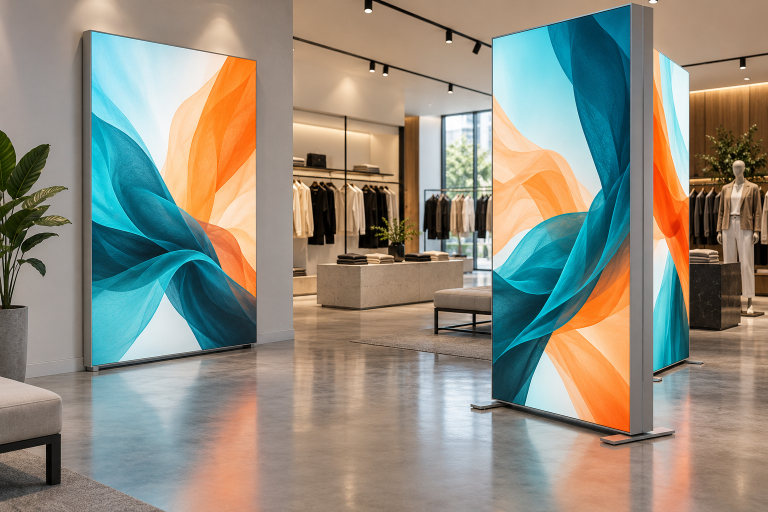
Replaceable graphics also make product launches easier. A reusable SEG lightbox exhibition booth can keep the same illuminated frame while the fabric graphic changes for a new product, market, or language.
The company should create a basic graphic guide covering:
- Logo position and safe area
- Approved colors
- Graphic dimensions
- Bleed requirements
- File formats
- Image quality
- Panel identification
Local messages should come from real customer questions, not broad assumptions about a country. Ask local teams which certifications, applications, service questions, and delivery concerns matter at that event.
Test Setup Time Properly
Modular systems often use repeated connectors and labeled parts, but not every system is quick to build.
A large stand may still require installers, electricians, riggers, audiovisual staff, or engineers.
Ask what the supplier’s setup estimate includes. It should cover:
- Unloading
- Flooring
- Main structure
- Graphics
- Lighting
- Screens
- Cable routing
- Product placement
- Testing
- Final cleaning
Record both elapsed time and total labor hours.
For example:
- Four installers working for 3.5 hours use 14 labor hours.
- Two installers working for 5 hours use 10 labor hours.
The first team finishes sooner, but the second uses fewer total labor hours. The lower-cost choice depends on local hourly rates, venue deadlines, and overtime rules.
Complete a test build before the first shipment. A sample test record may show:
| Installation crew | 4 people |
| Full setup | 3.5 hours |
| Total setup labor | 14 labor hours |
| Dismantling | 2.5 hours |
| Repacking | 1 hour |
Use the real test result for future planning rather than relying only on a sales estimate.
Check Packing Volume as Well as Weight
A lightweight stand can still be expensive to transport if it uses many large or partly empty cases.
Before purchase, ask for:
- Number of cases
- Dimensions of every case
- Weight of every case
- Total packed weight
- Total packed volume
- Length of the largest part
- Stacking limits
- Forklift or pallet requirements
Consider two example systems that both weigh 250 kg:
| Option | Cases | Total volume | Total weight |
|---|---|---|---|
| Option A | 6 | 2.4 m³ | 250 kg |
| Option B | 9 | 3.6 m³ | 250 kg |
Option B uses 50% more space even though both shipments have the same weight. It also adds three more cases to loading, customs checks, storage, venue delivery, and repacking.
Cases should be numbered and packed by booth area. Each case should have a content list or photograph so local crews can find parts quickly.
Choose the Right Shipping Plan
International exhibitors usually use one of three shipping plans.
One global kit: the same stand travels between countries. This limits duplicate inventory but creates a schedule risk when events are close together.
Regional kits: separate systems are stored in major markets. This reduces long-distance freight but increases purchase, storage, and inventory costs.
Hybrid shipping: branded graphics and special displays are shipped, while flooring, furniture, screens, and generic equipment are rented locally.
Timing is as important as price. Consider two shows that are 14 days apart:
- Dismantling and condition check: 2 days
- Freight: 5 days
- Customs clearance: 3 days
- Venue delivery: 1 day
- Next installation: 1 day
This plan already uses 12 days and leaves only two days for delays or repairs. A regional or hybrid system may be safer even if the direct freight quote is higher.
Prepare Customs Documents
A reusable stand does not avoid customs. Its advantage is that the company can maintain a clear and repeatable inventory.
The packing list should include:
- Part name and code
- Quantity
- Material
- Weight and dimensions
- Declared value
- Country of origin
- Serial number where available
Photographs and serial numbers can help show that returning equipment is the same equipment that was temporarily exported.
An ATA Carnet is an international customs document that permits duty-free and tax-free temporary import of eligible goods for up to one year in participating customs territories.[1]
For trade shows in the United States, U.S. Customs and Border Protection recommends carrying event details, proof of exhibitor status, item values, tariff codes, and any product permits. CBP states that a Temporary Importation Under Bond or an ATA Carnet may be suitable for display booths or other goods that will leave the United States after the visit.[2]
Under the European Union’s temporary admission procedure, qualifying non-Union goods intended for re-export may receive total or partial relief from import duty. Unless another rule applies, the maximum period for the same use and authorization holder is normally 24 months.[3]
Samples, food, batteries, liquids, printed giveaways, and products that will be consumed or left behind may be treated differently from reusable booth parts. Confirm the process with a qualified customs broker before shipping.
Check Venue Rules Before Production
Every event has its own technical manual. Review it before approving production.
Common rules cover:
- Maximum stand height
- Length of closed walls
- Number of open sides
- Raised floors and ramps
- Enclosed rooms and ceilings
- Fire-resistant materials
- Glass panels
- Emergency exits
- Electrical work
- Hanging signs
- Structural loads
A booth accepted at one venue may need changes at another. The supplier should provide drawings, material details, electrical information, and certificates, but the current layout still needs event-specific approval.
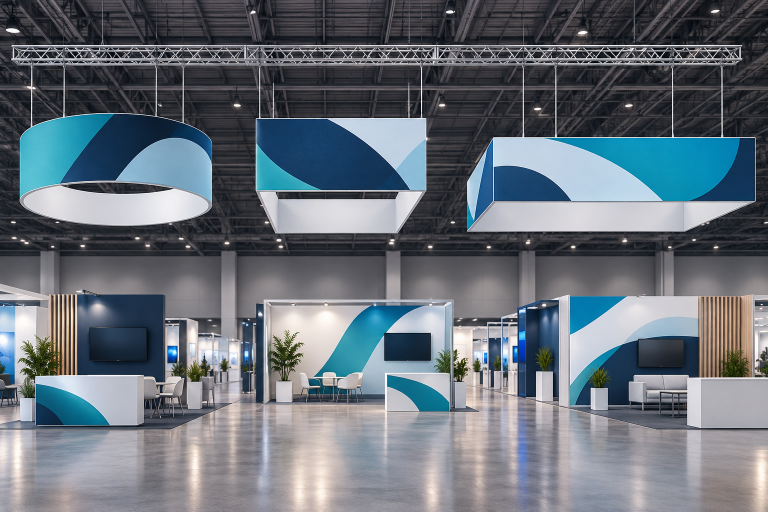
Overhead signs can help visitors locate a booth in a large hall, but they usually require rigging approval. Check height, weight, rigging points, and organizer rules before ordering a hanging banner display.
Plan Electrical Safety
Lightboxes, screens, demonstration equipment, chargers, and media players need safe power and cable routes.
For exhibitions and similar events in the United States, OSHA rules cover portable wiring and equipment. Equipment and wiring must be protected where physical damage is possible, and cables in public traffic areas must be guarded or covered so they do not create a trip hazard.[4]
In practical terms:
- Do not run exposed cables across entrances.
- Keep connectors away from visitor traffic.
- Leave ventilation around power supplies and media players.
- Make electrical parts easy to reach for repair.
- Confirm which work must be completed by the venue’s approved electrician.
Do not hide a failed power supply behind a wall that takes an hour to remove.
Plan for Accessibility
Accessibility should be checked each time the booth layout changes.
Review:
- Step-free access
- Safe floor edges
- Clear entrances
- Space around products and meeting tables
- Lower counter sections
- Reachable screens and information
- Seating
- Clear exit routes
The U.S. Access Board states that accessibility requirements apply to temporary as well as permanent facilities and lists wall systems and exhibit areas among the examples.[5]
Moving one counter can block a route that was clear in the previous layout. Test the real booth with furniture, screens, samples, and cables in place.
Rules vary by country and venue, so do not treat one measurement as a worldwide standard.
Prepare Technology and Lead Capture
Screens, cameras, speakers, media players, and lead-capture devices need power, cable routes, ventilation, secure mounts, and backup plans.
Prepare:
- Offline copies of videos and presentations
- Spare cables and adapters
- A spare media player or laptop
- Power supplies suitable for the destination
- Secure device storage
- A manual lead form if the network fails
Avoid building the entire booth around one screen model. Screen sizes and connection types may change during the life of the stand.
When the EU General Data Protection Regulation applies, personal data must be collected for a clear purpose and limited to what is necessary.[6]
Do not collect extra badge or contact data simply because the scanning tool allows it. Decide what staff need for follow-up and who is allowed to access it.
Measure Booth Performance
A reusable system allows the company to test layout changes over several events.
A sample visitor funnel might look like this:
| Stage | Example count | Example rate |
|---|---|---|
| People passing the booth | 1,200 | Starting point |
| People who stop | 180 | 15% of passers-by |
| Visitors who enter | 90 | 50% of people who stop |
| Useful conversations | 35 | 38.9% of entrants |
| Qualified leads | 12 | 13.3% of entrants |
These figures only show how to calculate the funnel. They are not industry benchmarks.
If the total stand-related event cost is $24,000 and the event creates 12 qualified leads, the cost is $2,000 per qualified lead. This figure does not show final profit, but it helps compare similar events.
Also record:
- Installation labor hours
- Freight weight and volume
- Damage and missing parts
- Graphic replacement cost
- Meetings and demonstrations
- Staff comments
- Visitor questions
The booth is only one factor. Event quality, location, staff performance, product demand, pre-show marketing, and follow-up also affect results.
Measure Reuse and Waste
A modular stand can reduce waste only when its parts are reused enough times. Reusable does not automatically mean environmentally friendly.
The U.S. Environmental Protection Agency places source reduction and reuse above recycling, energy recovery, and disposal in its materials-management hierarchy.[7]
Record:
- Number of times the frame is used
- Percentage of parts reused at each event
- Area or weight of new graphics
- Weight of discarded materials
- Number of repaired parts
- Freight weight and transport method
- Amount of equipment rented locally
For example, if 85 of 100 structural parts are reused, the structural reuse rate is 85%. If 12 m² of a 60 m² graphic set is replaced, the graphic replacement rate is 20%.
Transport must be included. A heavy booth sent by air between continents may have a greater impact than a system stored near the main event markets.
ISO 20121:2024 provides requirements and guidance for managing the social, economic, and environmental effects of events and applies to events of different types and sizes.[8]
Avoid claims such as “zero waste” or “fully sustainable” unless the company can show what was reused, repaired, shipped, recycled, and discarded.
Control Inventory and Repairs
Every owned component should have a record containing:
- Part code
- Description
- Quantity
- Storage location
- Condition
- Last use
- Repair status
- Replacement cost
For example, a 120-item inventory check finds:
- Three missing connectors
- Two failed lights
- 115 items ready for use
The exception rate is:
5 problem items ÷ 120 recorded items = 4.2%
The rate helps the team track whether inventory condition is improving or getting worse. It does not replace a detailed repair list.
For small parts that commonly disappear or fail, the packing plan may include a 5% to 10% spare allowance. A shipment with 100 small fasteners, for example, may carry 5 to 10 extras. Critical lightbox types may also need one spare power supply.
These are planning allowances, not fixed industry requirements. The right quantity depends on failure risk, replacement lead time, and the effect of a missing part.
Before buying, ask:
- Which parts are standard and which are proprietary?
- How much do replacements cost?
- How long does delivery take?
- Can parts be supplied near the event?
- How long will the system remain supported?
- Who owns the drawings and graphic measurements?
Give one person or team responsibility for inventory. Without a named owner, records are often not updated and damage is discovered too late.
Buy, Rent, or Use a Hybrid System
Buy when the event schedule is stable, booth sizes repeat, storage is available, and the company can manage the equipment.
Rent when testing a market, attending one event, changing the brand, or using a booth size that is unlikely to be repeated.
Use a hybrid system when branded graphics, lightboxes, counters, or product mounts need to stay consistent, but flooring, furniture, screens, and basic structures can be rented locally.
The decision can be reviewed with five figures:
- Expected number of events over three to five years
- Average structural reuse rate
- Storage cost per year
- Average freight volume per event
- Average repair and graphic-update cost per event
Buyers can compare aluminum booths, lightboxes, tension-fabric systems, hanging signs, and related formats through Milin’s exhibition display solutions.
Questions to Ask a Supplier
Do not choose a system from a rendering alone. Ask for drawings, real packing figures, and a complete test build.
- How many layouts can the same inventory create?
- What percentage of parts is reused in each layout?
- Which layouts require additional parts?
- What are the packed weight and volume?
- How many people and labor hours are needed?
- What work requires electricians or riggers?
- Which parts are most likely to fail?
- What are the replacement prices and delivery times?
- What drawings and certificates are included?
- Can other installers work with the system?
- What is excluded from the quotation?
Before final payment, confirm that:
- The delivered parts match the bill of materials.
- The planned layouts can be built.
- The graphics fit correctly.
- The lights and screens work.
- The cases hold the listed parts.
- The setup and packing instructions are complete.
Conclusion
A modular exhibition stand works best when the same inventory supports several confirmed events. Compare the full three-to-five-year cost, including storage, freight, graphics, labor, and repairs. Check the reuse rate across at least three common layouts, record case weight and volume, and complete a timed test build before shipping. A system that reuses 70% or more of its structure in normal layouts may be more useful than one with many rarely used parts. If the booth needs frequent redesign, ships in oversized cases, or has no inventory owner, renting or using a hybrid system may be the safer choice.