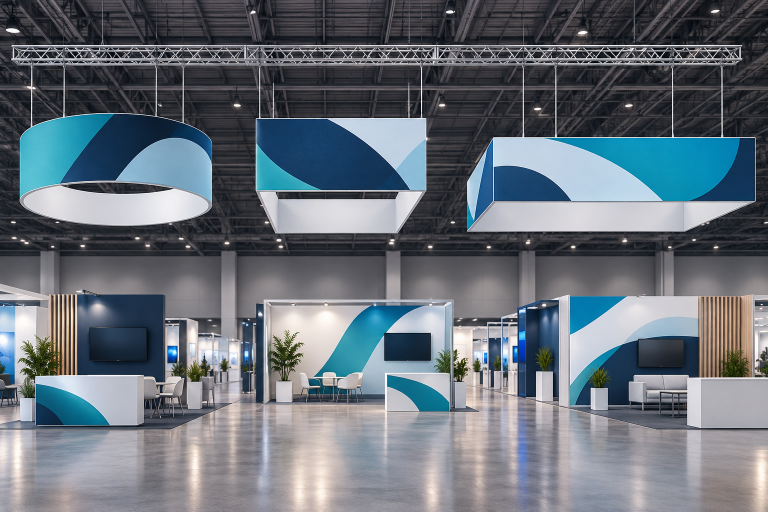
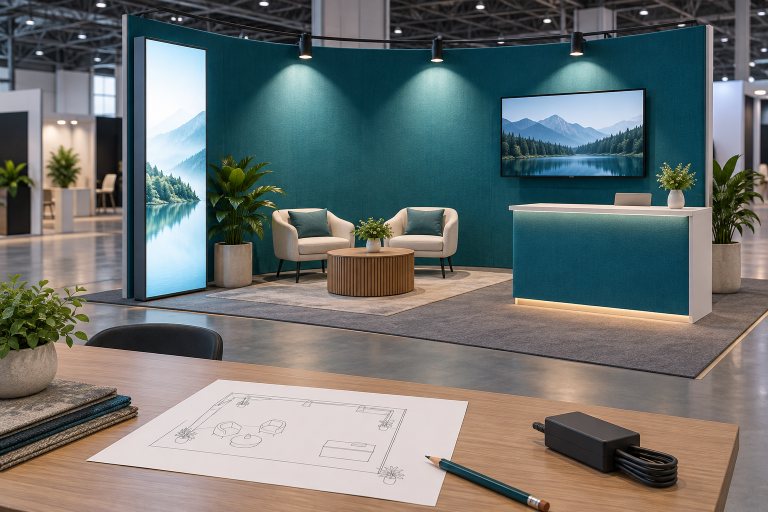
A custom trade show booth package can cost from about $7,000 for a simple 10×10 modular booth to more than $350,000 for a large custom exhibit. This usually does not include floor space, freight, material handling, labor, electricity, internet, travel or marketing. The complete event budget can therefore be much higher than the booth supplier’s quote.
| Booth size | Booth package planning range | Total event planning range |
|---|---|---|
| 10×10 | $7,000–$25,000 | $20,000–$60,000+ |
| 10×20 | $15,000–$50,000 | $40,000–$120,000+ |
| 20×20 | $40,000–$120,000 | $100,000–$300,000+ |
| 20×30 | $70,000–$180,000 | $160,000–$450,000+ |
| 30×30 | $130,000–$350,000+ | $280,000–$700,000+ |
These are planning ranges, not fixed prices. The final amount depends on the show, city, booth type, materials, packed weight, technology, labor schedule and ordering deadlines. A lightweight modular booth can cost far less than a booth of the same size with meeting rooms, custom woodwork, an LED wall and a hanging sign.
What Is Included in a Booth Quote?
Before comparing prices, separate the booth package from show services and the full event budget. CEIR’s exhibitor-spending research treats exhibit space, staffing, design and promotions as separate budget areas. A booth supplier’s quote should therefore not be treated as the total cost of attending a show.[1]
| Cost type | Usually includes |
|---|---|
| Booth package | Design, structure, graphics, counters, lighting, flooring, furniture, packing and project management, depending on the quote |
| Show services | Material handling, installation labor, electricity, internet, rigging, cleaning, plumbing and security |
| Total event cost | Floor space, booth package, show services, freight, travel, staffing, marketing and contingency |
Ask the supplier to mark every line as included, excluded, rented, purchased, optional or estimated by a third party. The word “turnkey” is not useful unless the quote clearly lists everything covered by the price.
Also confirm the booth type. A portable banner wall is not the same product as a reusable aluminum exhibition booth with integrated graphics, lighting and counters. Both may fit a 10×10 space, but their weight, setup time, appearance and useful life are different.
How Much Does a Booth Cost Per Square Foot?
Cost per square foot is useful for early planning, but it cannot replace a detailed quote.
| Booth level | Planning range | Typical scope |
|---|---|---|
| Portable or basic modular | $70–$150 per sq. ft. | Standard frame, fabric or panel graphics, simple flooring and limited furniture |
| Custom rental | $150–$300 per sq. ft. | Custom layout, storage, counters, backlighting and moderate technology |
| Premium custom exhibit | $300–$400+ per sq. ft. | Premium finishes, private rooms, engineering, large displays and special fabrication |
These figures describe the booth package, not the complete event. A 10×10 booth contains 100 square feet. At $100 per square foot, the booth package would cost $10,000. At $300 per square foot, the same booth area would cost $30,000.
A 20×20 booth contains 400 square feet. At $200 per square foot, the booth package would cost about $80,000. At $300 per square foot, it would cost about $120,000.
Small booths can have a high cost per square foot when they include expensive fixed items such as an LED wall, a custom reception counter or a private meeting room. Larger modular booths may spread design and project-management costs across more floor area.
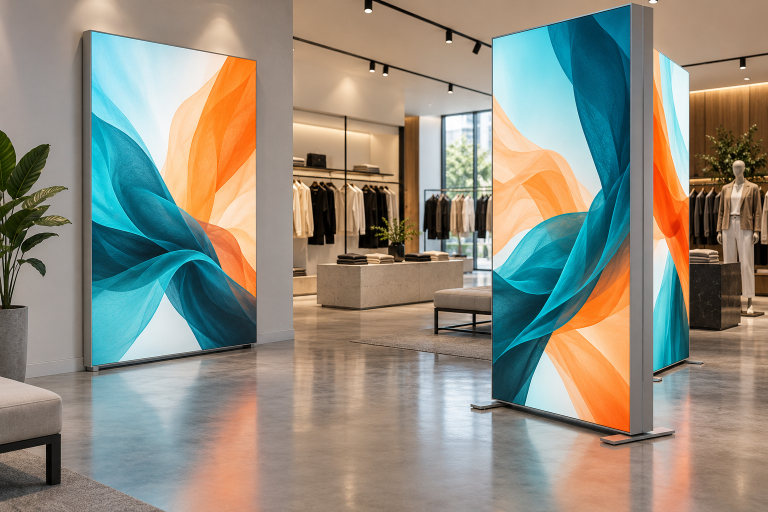
Material choice changes both the booth price and later service costs. A tension-fabric backdrop is usually lighter than a rigid wall. A SEG lightbox booth adds lighting and power demand but allows the frame to be reused with new graphics.
Floor Space
Show organizers normally charge for floor space by square foot. The rate varies by show, city, industry, booth location and booth type. Corner and island spaces may also have extra charges.
A 10×10 booth contains 100 square feet. At $50 per square foot, the space costs $5,000. At $75 per square foot, it costs $7,500. At $100 per square foot, it costs $10,000.
A 20×20 booth contains 400 square feet. At $75 per square foot, the space costs $30,000. At $100 per square foot, it costs $40,000.
Check whether the space fee includes carpet, exhibitor badges, furniture or limited material handling. Some organizers provide only an empty marked area.
Do not select a booth only because it is near an entrance. High traffic is not always useful traffic. A location near a relevant product zone, conference room or complementary supplier may produce fewer visitors but more qualified conversations.
Booth Type, Design and Construction
| Booth type | Best use | Main cost issue |
|---|---|---|
| Portable display | Small local shows and simple 10×10 spaces | Low price and low weight, but limited layout options |
| Modular system | Several shows or changing booth sizes | Reusable parts and replaceable graphics |
| Custom rental | Branded design without long-term ownership | Flexible, with less storage and repair responsibility |
| Custom purchase | Frequent use with a stable footprint | Higher first cost plus storage, repair and repeated freight |
A simple booth may need one floor plan, one rendering and standard components. A complex booth may need several concepts, structural calculations, product-load checks, approval drawings and coordination with electrical, audiovisual and rigging teams.
Before approving a major feature, ask how it changes:
- Production cost
- Packed weight and crate count
- Installation and dismantling hours
- Electricity, internet, rigging or plumbing
- Engineering and venue approval
- Future reuse and repair
A private meeting room adds more than four walls. It may also need a door, lighting, furniture, ventilation planning and fire-safety approval. A hanging sign adds the sign, engineering, rigging equipment, lift labor, dismantling and storage.
Weight affects more than shipping. If a redesigned booth is 500 pounds lighter, material handling alone could fall by about $1,140 when calculated at a $2.28-per-pound benchmark. Freight and warehouse handling may also decrease.
If a booth is reduced by 1,000 pounds, the same benchmark produces a possible material-handling reduction of about $2,280 before any shipping savings are counted.
For buyers comparing display formats, Milin’s exhibition display range includes modular booths, lightboxes, fabric backdrops, hanging banners and LED display systems.
Graphics, Flooring and Furniture
Graphic costs include design work, artwork preparation, printing, finishing, installation and replacement. Confirm the number, size, material, ownership and replacement price of every graphic.
In many rental projects, the structure is returned but the printed graphics are kept or discarded by the exhibitor. Ask how much replacement graphics will cost before planning to reuse the booth at another show.
Basic carpet for a small booth may cost several hundred dollars. Padded carpet, vinyl, printed floors, reusable hard floors and raised platforms can cost several thousand dollars after installation, ramps, freight and removal are included.
Furniture should support a real activity. Use a counter for greeting and lead capture, a high table for short talks and an enclosed table only when private meetings are necessary. Large sofas can take up valuable floor space without helping the sales team.
For example, a 10×10 booth provides only 100 square feet. After allowing space for a back wall, counter and storage, adding a large sofa and coffee table may leave too little room for visitors and staff to move safely.
Accessible routes, ramps, floor changes and service counters should be checked before production. The U.S. Department of Justice’s 2010 ADA Standards include requirements for accessible routes, ramps, floor surfaces and sales or service counters.[2]
Technology, Internet and Rigging
Technology costs may include screens, LED walls, media players, mounts, content production, programming, power, internet and technical support. A screen rental alone is not the full technology budget.
| Technology level | Planning range | Typical setup |
|---|---|---|
| Basic | $2,000–$8,000 | One or two screens, mounts, media players and basic installation |
| Interactive | $10,000–$30,000 | Several screens, touch controls, custom content and support |
| Large-format | $30,000–$100,000+ | LED wall, structural support, special power and on-site technicians |
A mobile LED screen wall should be selected only after checking viewing distance, content resolution, power, support structure and the result it is expected to produce.
A $5,000 screen package may still require $1,000–$3,000 for content editing, installation, cables, power and technical support. Ask for these items separately so the equipment price is not mistaken for the full technology cost.
Store important videos, presentations and lead forms offline. Confirm the network name before connecting to public Wi-Fi; CISA recommends verifying the legitimate hotspot name and password before use.[3]
A hanging sign can improve visibility, but the sign itself may be only a small part of the total cost. Check the show’s height limits, submission deadline and approved rigging provider before ordering a hanging banner system.
Shipping and Material Handling
Shipping and material handling are different charges. Shipping moves the crates to the venue or advance warehouse. Material handling, also called drayage, covers unloading, moving freight to the booth, storing empty crates, returning them after the show and moving the packed shipment back to the loading area.
The Exhibitor Advocate’s 2025 survey covered 23 U.S. cities. It reported that the average base material-handling rate rose 9.5% to $2.28 per pound, while electrical outlet rates rose 18.4%. These are benchmark figures, not guaranteed prices for a specific show.[4]
| Shipment weight | Example at $2.28 per pound |
|---|---|
| 500 lb. | $1,140 |
| 1,000 lb. | $2,280 |
| 2,000 lb. | $4,560 |
| 5,000 lb. | $11,400 |
The final bill may be higher because of minimum weights, loose freight, overtime, late arrival, special equipment or separate minimum charges for several small shipments.
For example, five 40-pound boxes have a combined weight of 200 pounds. However, if every shipment is subject to a 200-pound minimum, the contractor may bill the shipment as 1,000 pounds rather than 200 pounds. At $2.28 per pound, that would mean $2,280 instead of $456.
Request the packed weight, crate count, dimensions, freight class, shipping origin, delivery method and return plan before production begins.
OSHA requires stacked materials to be stable and secure against sliding or collapse, so crates and stored booth parts also need safe packing and stacking.[5]
Installation Labor
Installation and dismantling labor depends on worker count, worker-hours, local rules, move-in times, supervision and booth complexity.
Compare quotes in worker-hours. Four workers for four hours equals 16 worker-hours. Three workers for six hours equals 18 worker-hours, even though the second supplier uses fewer people.
For example, four workers scheduled for four hours create 16 worker-hours. At an assumed rate of $150 per worker-hour, the labor cost is $2,400.
If the same work is completed at a 1.5-times overtime rate, the hourly rate becomes $225 and the labor cost rises to $3,600. A two-hour delay that pushes work into overtime can therefore add a large amount to the bill.
Some official event manuals apply a one-hour minimum per worker and then bill in half-hour steps. The 2026 National College Fair Houston service manual uses this method, showing why even a short task can create a full minimum charge.[6]
Suppose four workers are called for a job that takes only 30 minutes. With a one-hour minimum and an assumed rate of $150 per worker, the minimum labor charge would still be $600.
Labor rises when freight is late, instructions are unclear, parts are missing, graphics do not fit or workers wait for approval. Numbered parts, labeled crates and clear setup drawings can reduce wasted time.
Electricity
List the rated power and location of every light, screen, laptop, refrigerator and product demonstration. Ask the official electrical provider to confirm the correct service. Do not order power from rough guesses.
For example, four screens using 150 watts each create a load of 600 watts. Ten 20-watt lights add 200 watts, three 90-watt laptop chargers add 270 watts and one 300-watt refrigerator brings the total estimated load to 1,370 watts.
Adding a 25% planning margin increases the estimated load to about 1,700 watts. This example helps with early planning, but the official electrical contractor should confirm the final circuit and service requirements.
| Equipment | Quantity | Example wattage | Total load |
|---|---|---|---|
| Display screens | 4 | 150 watts each | 600 watts |
| LED lights | 10 | 20 watts each | 200 watts |
| Laptop chargers | 3 | 90 watts each | 270 watts |
| Refrigerator | 1 | 300 watts | 300 watts |
| Total | 1,370 watts |
Electrical cables in public areas must be protected. OSHA’s rules for exhibitions and similar events state that cables accessible to the public should be covered and arranged so they do not create a tripping hazard.[7]
Travel, Staffing and Marketing
A travel budget should state the number of travelers, hotel nights, airfare, taxes, local transport, meals, baggage and whether technical staff must arrive early.
GSA publishes location-based lodging and meals-and-incidental rates that can be used as a neutral starting point, although company travel costs may be higher.[8]
A four-person team attending a three-day U.S. show may spend about $5,000–$15,000 on flights, three to four hotel nights, meals and local transport. The actual amount depends heavily on the city, booking date and travel distance.
For example, four round-trip flights at $600 each cost $2,400. Four hotel rooms for four nights at $250 per night cost $4,000. Adding $1,200 for meals and $600 for local transport produces a total travel budget of about $8,200.
Match staff numbers to the booth. Six employees can overcrowd a 10×10 space, while two people may not cover a 20×20 island with several demonstration areas.
Assign roles for greeting, qualification, demonstrations, technical questions, meetings and lead recording before the show.
Marketing should cover the whole event cycle:
| Stage | Main work |
|---|---|
| Before the show | Target-account outreach, invitations, meeting booking and product announcements |
| During the show | Demonstrations, lead qualification, meetings and lead capture |
| After the show | Lead assignment, sales follow-up and performance review |
Do not spend the full budget on the structure. A smaller booth with booked buyer meetings can produce better results than a larger booth that depends only on passing traffic.
Sample 10×10 Booth Budget
| Cost | Example budget |
|---|---|
| Floor space | $7,500 |
| Design, structure and project management | $10,000 |
| Graphics | $2,000 |
| Flooring and furniture | $1,500 |
| Shipping | $1,500 |
| Material handling | $2,000 |
| Installation and dismantling | $1,500 |
| Electricity and internet | $1,500 |
| Staff travel | $6,000 |
| Marketing | $1,500 |
| Contingency | $3,000 |
| Total | $38,000 |
This example assumes a professional rental booth, a small team, normal deadlines and no heavy machinery or large LED wall.
Sample 10×20 Booth Budget
| Cost | Example budget |
|---|---|
| Floor space | $15,000 |
| Design, structure and project management | $25,000 |
| Graphics | $4,000 |
| Flooring and furniture | $3,500 |
| Technology | $4,000 |
| Shipping | $3,000 |
| Material handling | $4,000 |
| Installation and dismantling | $4,000 |
| Electricity and internet | $3,000 |
| Staff travel | $10,000 |
| Marketing | $3,000 |
| Contingency | $7,000 |
| Total | $85,500 |
This budget supports two or three clear areas, such as reception, product demonstration and a small meeting area. Adding a private room, hanging sign or large display can push the cost above this example.
For an $85,500 event budget, a 10% contingency equals $8,550 and a 15% contingency equals $12,825. A first-time exhibitor, rushed project or technology-heavy booth may need a contingency closer to the upper end.
Sample 20×20 Island Booth Budget
| Cost | Example budget |
|---|---|
| Floor space | $35,000 |
| Design, structure and project management | $70,000 |
| Graphics | $8,000 |
| Flooring and furniture | $8,000 |
| Technology | $15,000 |
| Shipping | $8,000 |
| Material handling | $10,000 |
| Installation and dismantling | $12,000 |
| Electricity and rigging | $10,000 |
| Staff travel | $18,000 |
| Marketing | $6,000 |
| Contingency | $18,000 |
| Total | $218,000 |
This example assumes a custom island booth with moderate technology, more staff and some rigging. Removing the hanging sign, reducing video equipment and using lighter parts can lower the budget.
Should You Rent or Buy?
| Factor | Rent | Buy |
|---|---|---|
| First cost | Lower | Higher |
| Storage | Usually limited | Required |
| Repairs | Often handled by supplier | Paid by owner |
| Design changes | Easier | May require new parts |
| Changing booth sizes | More flexible | May be limited |
| Best fit | Occasional shows or changing programs | Frequent reuse with a stable footprint |
Use total ownership cost, not only the purchase price:
Cost per use = total ownership cost ÷ realistic number of uses + event-specific freight, handling, labor and show services
For example, a booth costs $120,000 to buy and $15,000 per year to store, maintain and update. If it is used six times over three years, the ownership cost is $165,000, or $27,500 per use, before floor space, freight, handling, labor and utilities.
If the same booth is used only three times, the ownership cost rises to $55,000 per use. Buying only saves money when the booth is reused enough times and still fits the company’s future booth sizes and brand requirements.
Buying is more practical when the footprint is stable, the booth is used often and replacement parts are easy to obtain. Renting is safer when sizes change, the brand may change or shows are held in different countries.
Hidden Charges to Check
| Charge | Why it appears | How to control it |
|---|---|---|
| Late-order surcharge | Services are ordered after the discount deadline | Keep one deadline sheet with an owner for every order |
| Overtime labor | Work takes place at night, on weekends or on holidays | Match the design to official move-in and move-out hours |
| Change orders | The layout, graphics or utilities change after approval | Require a written price before work starts |
| Shipment minimums | Each small shipment receives a minimum handling charge | Consolidate freight where practical |
| Cleaning and waste | Vacuuming, waste removal or protective-film removal is excluded | Confirm the cleaning scope in writing |
| Storage handling | The monthly storage rate excludes receiving, inspection or release | Request the full warehouse fee schedule |
| Rental damage | Parts or furniture are returned damaged or missing | Photograph the booth before and after the show |
| Taxes and fees | Sales tax, payment fees, insurance or administration is excluded | Ask for the estimated final invoice, not only the base price |
| Customs and duties | International goods are delayed or entered under the wrong procedure | Confirm temporary-import documents and responsibility early |
A small on-site change can be expensive. Two workers for two hours at an assumed $150 per hour would cost $600. Add a $500 rush graphic and the change order could exceed $1,100 before delivery or overtime charges.
An ATA Carnet can simplify the temporary export and import of eligible exhibition goods, but it is intended for goods that will be re-exported rather than consumed or left behind.[9]
How to Compare Booth Quotes
Give every supplier the same written scope. Then compare these items line by line:
| Quote item | What to check |
|---|---|
| Design | Concepts, revisions, renderings and approval drawings |
| Structure | Materials, dimensions, rental or purchase status and replacement parts |
| Graphics | Quantity, size, material, artwork, ownership and replacement price |
| Technology | Models, mounts, content, programming, power and support |
| Flooring and furniture | Exact items, quantities, installation, removal and damage terms |
| Packing | Crate count, dimensions, packed weight and packing lists |
| Freight | Origin, delivery method, tracking, insurance and return plan |
| Show services | Included, estimated or paid directly by the exhibitor |
| Labor | Worker-hours, rates, minimums, waiting time and overtime |
| Schedule | Artwork, approval, production, service and freight deadlines |
| Fees | Tax, project management, payment, rush and cancellation charges |
Do not choose the lowest total until every quote covers the same items. A $25,000 quote that excludes $4,000 of graphics, $4,000 of labor and $3,000 of packing and freight is not cheaper than a complete $34,000 quote.
How to Reduce Booth Cost
- Reduce weight and crate volume: Use lightweight frames, tension fabric and detachable panels where the design allows.
- Make setup simple: Number parts, use standard hardware and provide clear drawings to reduce worker-hours.
- Reuse the frame: Keep the structure and replace only the graphics when products or messages change.
- Order services early: Submit electricity, internet, labor, furniture and rigging orders before discount deadlines.
- Rent local items: Compare local furniture and screen rental with the cost of freight, handling and storage.
- Remove unused features: Cut any room, screen, counter or sign that does not support meetings, demonstrations, lead capture or wayfinding.
Suppose a lighter design removes 500 pounds of packed weight and saves eight installation worker-hours. At $2.28 per pound, the material-handling reduction is about $1,140. At an assumed labor rate of $150 per hour, eight fewer worker-hours save another $1,200. The combined saving is about $2,340 before freight and storage savings.
Reusable frames and replaceable graphics can reduce repeated production and disposal. EPA’s materials-management guidance gives priority to reducing and reusing materials before lower-value disposal options.[10]
How to Measure Trade Show ROI
Total event cost = floor space + booth package + show services + freight + travel + staffing + marketing + contingency
Cost per qualified lead = total event cost ÷ qualified leads
Pipeline return = event-attributed opportunity value ÷ total event cost
| Example result | Calculation | Result |
|---|---|---|
| 80 qualified leads from a $38,000 event | $38,000 ÷ 80 | $475 per qualified lead |
| 30 completed buyer meetings from an $85,500 event | $85,500 ÷ 30 | $2,850 per meeting |
| $600,000 in qualified pipeline from a $218,000 event | $600,000 ÷ $218,000 | 2.75× pipeline return |
Define a qualified lead before the event. A badge scan alone does not show buying intent. Record company fit, decision role, project timing, budget, product interest and the agreed next step.
Also track scheduled meetings, completed demonstrations, target-account conversations, proposal requests and revenue influenced after the show. For long sales cycles, review results over several months rather than expecting immediate revenue.
Conclusion
A realistic trade show budget must include more than the booth supplier’s quote. Under the examples above, a professional 10×10 event costs about $38,000, a 10×20 event about $85,500 and a custom 20×20 island about $218,000. The biggest risks are unclear quote scope, heavy crates, separate shipment minimums, overtime labor, late orders and on-site changes. Compare suppliers with the same item list, confirm packed weight and worker-hours, and reserve about 8%–15% for unexpected costs. Spend first on clear demonstrations, booked meetings and reliable lead capture, then remove features that do not support those goals.