The right trade show booth manufacturer should provide relevant project evidence, clear material specifications, a complete quotation, and a workable delivery plan. Do not choose a supplier from renderings or price alone. Compare what each company will make, what it will outsource, which costs are excluded, how the booth will be tested, and who will solve problems at the venue.
For most projects, start with three to five qualified suppliers. After reviewing their experience, initial designs, prices, and delivery ability, reduce the list to two or three suppliers for the final technical and commercial comparison. Before signing a contract, you should have an approved floor plan, material list, itemized quotation, project schedule, installation plan, ownership terms, and warranty terms.

Define What the Booth Must Do
Start with the work the booth must support. A booth for product demonstrations needs a different layout from one used for private meetings. A machinery booth may need reinforced flooring, technical access, ventilation, and extra power. A distributor meeting booth may need several tables and a quieter discussion area.
Give every shortlisted supplier the same information:
- Booth size and number of open sides
- Show name, venue, country, and dates
- Products and services being promoted
- Product dimensions and weights
- Expected number of staff and visitors
- Number of meetings or demonstrations happening at the same time
- Required storage space
- Power, water, drainage, ventilation, compressed air, or internet needs
- Main brand message
- Target budget and final approval date
The following figures are early planning examples, not fixed capacity rules:
| Booth Size | Example Staff Level | Possible Functions |
|---|---|---|
| 9 m² | 2–3 staff | One main product or graphic area and short visitor conversations |
| 18 m² | 4–6 staff | One display or demonstration zone and one small discussion area |
| 36 m² | 6–10 staff | Two or three visitor activities, storage, and a meeting area |
| 54 m² or more | 8–15 staff | Several display zones, larger meetings, demonstrations, and staff support space |
Actual capacity depends on product size, furniture, visitor traffic, accessibility needs, storage, and the number of open sides.
A useful starting point for space planning is:
| Function | Early Planning Range |
|---|---|
| Open visitor movement | 35%–50% |
| Product display or demonstration | 20%–35% |
| Meetings | 15%–25% |
| Storage and staff support | 8%–15% |
These percentages are only a starting point. Large machinery, private rooms, several demonstrations, or a single open side may require a different allocation.
Avoid vague requests such as “make it attractive” or “increase brand awareness.” Use requirements that can be checked in the floor plan. For example:
- Twenty people should be able to watch a demonstration without blocking the aisle.
- Two four-person meetings should be possible at the same time.
- The storage room must hold six staff bags, brochures, tools, and spare graphics.
- The main product must remain visible from both open sides.
- The screen must be readable from the main visitor route.
Divide the brief into three levels:
| Priority | Meaning |
|---|---|
| Must-have | The booth cannot operate properly without it. |
| Should-have | Important, but it can be adjusted if space or budget becomes limited. |
| Nice-to-have | Useful only when enough space and budget remain. |
Choose the Right Booth Type
The booth type should match your event plan, not just the first quotation. Compare initial cost, reuse, packed size, installation time, storage needs, and the cost of changing the layout.
Custom Booth
A custom booth is made for a specific space and event. It is suitable when you need unusual shapes, private rooms, large product areas, special finishes, or a strong one-off brand presentation.
The main risk is limited reuse. Ask which frames, lights, counters, screen supports, and storage parts can be used again. A custom design can still use a reusable core. For example, a modular aluminum exhibition booth can provide the main frame while graphics and decorative parts change for each event.
Before approval, request the estimated cost of using the booth at a second and third show. This should include new graphics, replacement parts, layout changes, packing, freight, storage, and installation.
Modular Booth
A modular booth uses standard frames and connectors that can be arranged in different sizes. It is useful when you attend several shows or frequently change booth dimensions.
Do not accept a few different renderings as proof of reuse. Ask for a component list showing:
- Which parts are used in each layout
- Which parts are left unused
- Which new parts must be purchased
- How much new graphic material is required
- The packed size and weight
- The expected installation team and setup time
Ask the supplier to show at least three layouts using the same inventory, such as 3 × 3 meters, 3 × 6 meters, and 6 × 6 meters. A booth is not truly flexible if each layout needs many new walls, counters, and custom parts.
Portable Booth
Portable displays are useful for conferences, dealer events, recruitment fairs, and small trade shows. Common options include fabric backdrops, pop-up walls, banner stands, portable counters, and compact lightboxes.
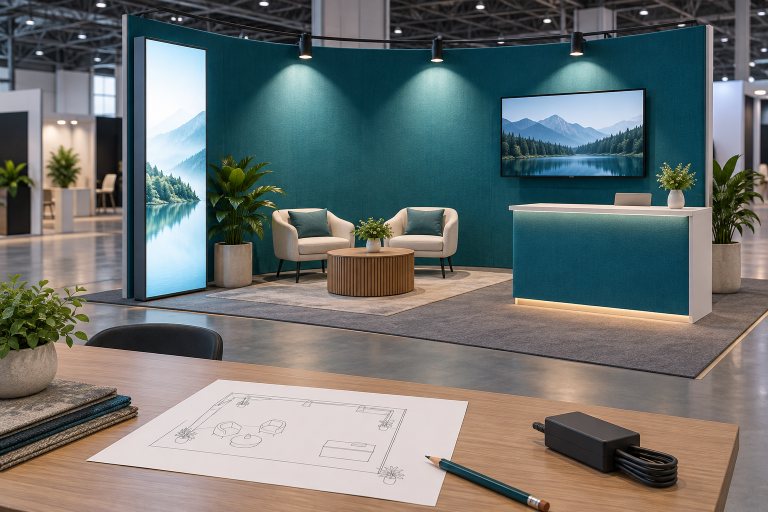
A tension fabric backdrop booth can provide a large printed wall with a lighter packing volume than many rigid-panel systems. However, the word “portable” does not tell you how many people are needed to move or install it.
Confirm:
- Number of cases
- Weight and dimensions of each case
- Number of installers
- Tools required
- Parts that need two-person lifting
- Real setup time
- Whether the cases fit your vehicle, elevator, loading door, and storage area
Request a continuous setup video from opening the cases to completing the display. A tool-free or single-tool system does not automatically mean that exhibitors are allowed to install it themselves. Check the event manual and local labor rules.
Rental Booth
A rental booth can reduce the need to buy and store a complete structure. It is often useful for one event, an overseas show, or a market test.
Confirm which parts are rented and which parts you must buy. The frame may be rented while graphics, flooring, and custom counters are purchased.
Ask about the return deadline, acceptable wear, cleaning fees, damage charges, missing-item charges, dismantling responsibility, and return freight. Compare the total cost across all planned events. Repeated rental, new graphics, and local labor may cost more than owning a reusable system.
Hybrid Booth
A hybrid booth combines several supply methods. For example, the main aluminum frame and graphics may be shipped from the manufacturer, while flooring, furniture, and installation labor are sourced near the venue.
This can reduce shipping volume, but the drawing must show who supplies each item and who checks its dimensions, finish, and color. Without clear responsibility, locally sourced items may not match the approved design.
Understand the Supplier’s Role
The words manufacturer, booth builder, design agency, rental provider, and exhibition contractor do not always describe the same service.
A supplier may:
- Design and manufacture most parts in its own factory.
- Manufacture the frame but outsource printing, furniture, or electrical work.
- Manage the project through several production partners.
- Produce the booth overseas and use a local installation company.
- Supply a rental structure with custom graphics.
Outsourcing is not automatically a problem. What matters is whether the supplier gives subcontractors clear specifications, checks their work, and accepts responsibility for its contracted services.
Ask for a responsibility table before placing the order:
| Task | Responsible Party | Approval Party |
|---|---|---|
| Concept design | ||
| Technical drawings | ||
| Graphic printing | ||
| Structural review | ||
| Event-rule submission | ||
| Packing and freight | ||
| Installation | ||
| Final handover | ||
| Dismantling and storage |
You should have one lead project manager, but do not assume that the manufacturer controls services reserved for the venue, organizer, official electrician, rigger, or freight contractor.
Check Relevant Experience
Website images alone do not prove that a supplier completed the work. A portfolio may contain renderings, old projects, stock images, or structures installed by another company.
Ask for three projects similar to yours. Check the booth size, event location, completion date, materials, installation method, and services provided.
The best evidence is a complete project record:
- Approved rendering
- Technical drawing
- Production photos
- Trial assembly photos
- Packing photos
- Installation photos
- Finished booth photos
Experience should match the actual risk. A supplier that mainly produces small backdrops may not be suitable for a tall booth with suspended signs and heavy machinery. A company may know the venue but have no experience with your product weight, power needs, or installation window.
When contacting a reference customer, ask whether the final price changed, whether the booth matched the approved drawings, whether materials were replaced, and how quickly on-site problems were solved.
Verify Production Control
A factory visit is useful when manufacturing ability is an important part of the decision. If an in-person visit is not possible, request a live video tour.
Check whether:
- Current production is taking place.
- Materials and finished parts are labeled.
- Drawings have dates and version numbers.
- Different customer projects are kept separate.
- Graphics are inspected before packing.
- Electrical parts are tested.
- There is enough space for trial assembly.
- Packed items are protected and counted.
A large factory does not always provide better control. A smaller company with clear drawings, inspections, and reliable production partners may perform better than a large factory with weak project management.
Review the Floor Plan
A rendering shows appearance. It does not prove that the booth is easy to use.
Request:
- Floor plan with full dimensions
- Wall heights
- Entrance widths
- Storage dimensions
- Door opening direction
- Product positions
- Screen and lighting positions
- Furniture sizes
- Graphic dimensions
- Views from every open side
Use the real dimensions of products, screens, chairs, counters, and storage items. A meeting area may look comfortable only because the rendering uses small furniture.
Ask the supplier to include two or three structured design revision rounds in the quotation. Unlimited small changes through email or messaging apps often cause old drawings, missed details, and schedule delays.
Test the layout under normal working conditions:
- A crowd gathers around the demonstration.
- Two meetings happen at the same time.
- Staff move samples from storage.
- A technician needs to reach a screen or light.
- A visitor using a mobility aid enters the booth.
- The storage door opens while visitors are present.
In the United States, the ADA Standards include requirements for accessible routes, floor surfaces, level changes, doorways, and service counters in covered facilities. The exact requirements for a temporary booth should be confirmed with the venue, organizer, and applicable local rules.[1]
Plan Brand Visibility
Visitors should be able to understand three things quickly: who you are, what you sell, and why they should stop.
Use different information at different viewing distances:
- Long distance: one company name or product category
- Medium distance: one main benefit or product message
- Close distance: three to five product facts or next steps
Keep the main aisle message to one clear idea, usually about 6–10 words. Do not ask visitors to read several headlines and a long paragraph before they understand the booth.
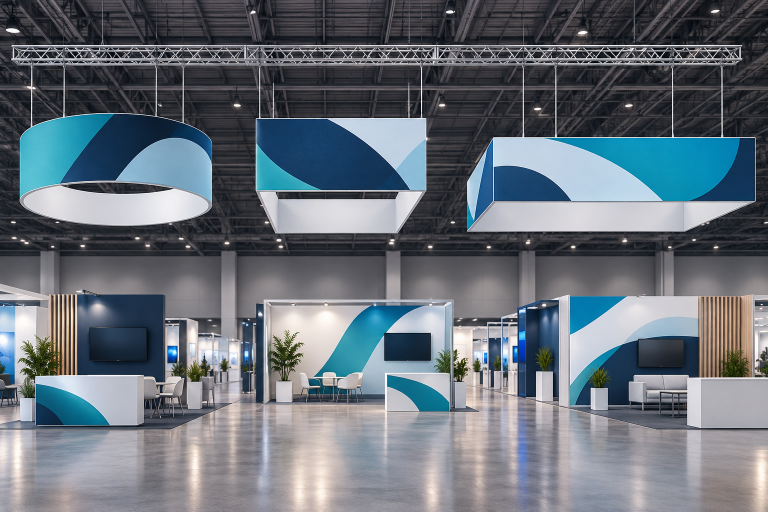
A venue-approved hanging banner can make a booth easier to find, but the rigging point, height, weight, installation company, and approval deadline must be confirmed first.
Plan Lighting and Screens
Lighting should make products, graphics, and walking areas easy to see. Confirm the fixture type, quantity, power, beam direction, mounting point, and cable route. Do not judge lighting only from a dark computer rendering.
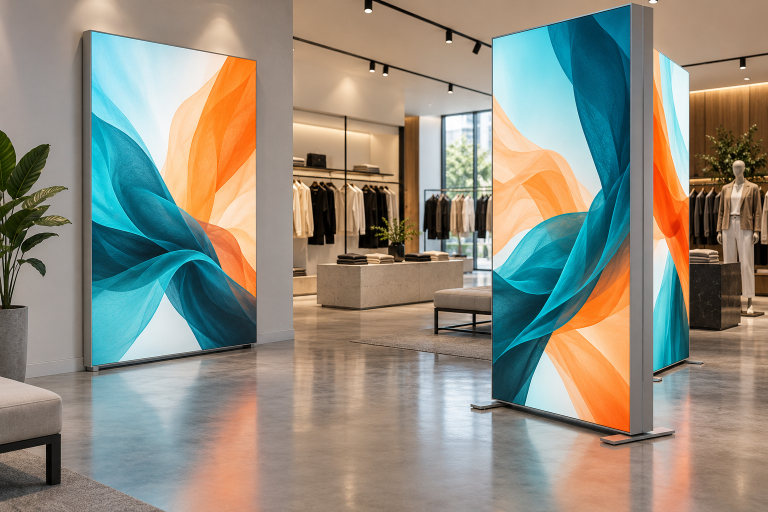
For a SEG lightbox booth, approve the printed fabric while it is illuminated. Check for dark areas, bright spots, loose fabric, visible seams, and color changes.
If the booth uses a mobile LED screen, confirm the screen size, weight, fixing method, viewing distance, power, ventilation, media format, and backup playback method. Keep an offline copy of the content, one spare signal cable, and one backup playback device.
For U.S. installation work covered by OSHA construction electrical rules, electrical equipment must be approved and suitable for its intended use.[2]
Check the Structure
Technical review is important when the booth includes tall walls, ceilings, large signs, heavy screens, shelves, doors, machinery, raised floors, or suspended parts.
Ask the supplier to explain:
- How walls are supported
- How movement or overturning is prevented
- How joints are connected
- How screens and shelves are fixed
- How the structure is leveled
- How product loads are transferred to the floor
- Which parts require organizer or engineer approval
Provide the exact weight, dimensions, and position of machinery, screens, and products. Total weight alone may not be enough. The base size, contact area, and center of gravity can also affect the design.
For higher-risk structures, request technical drawings, connection details, load information, fixing methods, and any approval documents required by the venue. Changes to wall height, screen size, or product position should be checked before production continues.
Specify Materials Clearly
Do not accept descriptions such as “premium aluminum,” “high-quality board,” or “eco-friendly fabric” without details.
| Component | Details to Confirm |
|---|---|
| Frame | Material, profile dimensions, wall thickness, finish, connector type, and replacement-part availability |
| Panels | Material, thickness, surface finish, edge protection, fire documents, and repair method |
| Fabric graphics | Fabric type, print method, edge finish, light-blocking layer, cleaning method, and replacement price |
| Hard graphics | Board material, thickness, print method, coating, mounting method, and panel joints |
| Flooring | Material, thickness, edge finish, cable route, load needs, and reuse plan |
The contract should state that important material changes require written approval. A replacement material should be compared for appearance, strength, weight, fire documents, durability, lead time, and cost.
Control Print and Brand Color
Color can change between monitors, printers, fabrics, boards, paint, and backlit graphics. A logo copied from a website is not a reliable production reference.
CMYK values depend on the output device and printing setup. The International Color Consortium explains the difference between device-dependent color data and device-independent color spaces used in color management.[3]
For important brand colors, provide:
- Pantone or another approved color reference where suitable
- CMYK values together with the intended ICC profile
- The material being printed
- The printing method
- A physical printed sample
- An illuminated sample for backlit graphics
- A painted or coated sample for rigid parts
Keep the approved physical sample as the production reference. Fabric, board, paint, and backlit graphics may need separate samples because they do not show color in exactly the same way.
Check the Event Manual
Send the current event manual to the supplier before approving the design.
The manual may control:
- Maximum booth height
- Open-side requirements
- Wall length
- Ceilings and covered areas
- Hanging signs and rigging
- Fire documents
- Electrical work
- Raised flooring
- Accessible entrances
- Machinery and utilities
- Installation hours
- Approved contractors
Create one approval tracker:
| Requirement | Responsible Party | Deadline | Status |
|---|---|---|---|
| Booth design approval | |||
| Structural review | |||
| Fire documents | |||
| Electrical order | |||
| Rigging order |
The contract should explain who pays when approval changes are required. The supplier should normally correct a design that ignored rules already provided. The buyer may be responsible when product information or design requirements change late.
Set the Full Project Budget
A booth quotation is only one part of the event cost. Your total budget may include design, production, graphics, furniture, freight, customs, material handling, electricity, rigging, installation, cleaning, storage, and return transport.
Use four separate figures:
- Target budget: the amount you would prefer to spend
- Maximum approved budget: the amount that requires new approval if exceeded
- Supplier quotation: the price for the supplier’s written scope
- Final landed event cost: the total cost of delivering, operating, dismantling, and removing the booth
As an internal planning example, a simple local project may reserve about 5%–10% of the approved budget for changes and uncertain charges. A custom booth involving international freight, several venue contractors, or a short schedule may need a 10%–15% planning reserve. This reserve is not permission to overspend; additional charges should still require approval.
Compare Quotations on the Same Basis
Do not compare quotations unless they cover the same booth size, materials, delivery location, installation period, currency, tax basis, and service scope.
An itemized quotation should separate:
- Concept and technical design
- Frame, walls, doors, and storage
- Graphics and printing
- Lighting, screens, and furniture
- Trial assembly and inspection
- Packing and freight
- Installation and dismantling
- Storage and repairs
Mark each cost as:
- Fixed: it changes only when the approved scope changes.
- Estimated: the final cost may change when more information is available.
- Allowance: a temporary amount for an item not yet selected.
- Pass-through: a third-party cost charged at the actual amount.
- Optional: not included unless approved.
- Venue charge: ordered from the venue or official supplier.
As an internal risk check, review any single item representing more than 10% of the quotation in detail. Confirm its quantity, specification, unit price, ownership, and conditions for change.
If estimated, allowance, pass-through, and excluded costs together may represent more than about 20% of the expected total event cost, do not treat the quotation as a reliable fixed budget. Ask for more information before final approval.
Common costs missed in early quotations include material handling, rigging, electricity, internet, cleaning, overtime, waiting time, empty-case storage, customs charges, return freight, and replacement graphics.
Do not allow open-ended extra work. The contract should state who can approve an additional charge, when the supplier must report it, and what evidence must be provided.
Check Reuse and Sustainability
A reusable booth should be easy to inspect, repair, pack, transport, and rebuild.
Ask for a reuse plan showing:
- Reusable frame parts
- Reusable lights, counters, and flooring
- Graphics that must be replaced
- One-time decorative parts
- Parts required for other booth sizes
- Packed volume and weight
- Expected repair and storage costs
Calculate the cost of the second and third event, including new graphics, repairs, storage, freight, and installation. A reusable frame does not guarantee low repeat costs if most visible parts must be replaced.
Broad claims such as “green,” “eco-friendly,” or “zero waste” should be supported by clear evidence. The U.S. Federal Trade Commission’s Green Guides explain how businesses can avoid misleading environmental marketing claims.[4]
ISO 20121:2024 provides a management-system framework for the social, economic, and environmental effects of events. Using a reusable frame alone does not show that a booth or event meets the standard.[5]
Confirm Ownership and Storage
The contract should state what you own after payment:
- Frame and custom parts
- Lights, screens, counters, and furniture
- Graphics and packing cases
- Editable design files
- Technical drawings
- Print files and component lists
Physical ownership does not automatically include design-file rights. Confirm whether you may move the booth to another warehouse, hire another installer, purchase replacement parts, or reproduce damaged graphics.
Before storage, request an inventory showing returned, missing, damaged, and repairable items. Confirm the monthly or annual storage fee, handling charge, insurance, access rules, inspection fee, and disposal cost.
Require Trial Assembly
A complex or newly designed booth should be assembled before shipping.
Trial assembly can find:
- Missing parts
- Incorrect holes or connectors
- Wrong dimensions
- Weak joints
- Misaligned graphics
- Lighting or screen problems
- Doors that do not open correctly
- Installation steps that take too long
For a complex booth, the trial assembly should normally cover 100% of the main structural components, all doors and moving parts, every lighting circuit, every screen support, and at least 10–20 critical dimensions from the approved drawings.
The quotation should state how much of the booth will be assembled. “Trial assembly included” should not mean that only a small frame section is tested.
Use this process:
- Build the agreed parts.
- Compare them with the approved drawings.
- Check important dimensions.
- Test lights, screens, doors, and shelves.
- Record defects and missing parts.
- Correct the problems.
- Verify the corrections before packing.
Check Spare Parts and Packing
For reusable systems, a practical spare quantity for common fasteners and connectors may be about 2%–5%, depending on the system and how difficult replacements are to obtain near the venue.
Every shipping package should show:
- Unique package number
- Contents and quantity
- Weight and dimensions
- Handling marks
- Installation area
- Fragile or high-value identification
The final packing list should account for 100% of the packages before release. Small fittings should be placed in labeled boxes. Request packing photos before every case is closed.
Identify the first 5–10 packages needed during installation so they can be unloaded in the correct order. These may include tools, floor plans, main connectors, base plates, and the first structural sections.
Plan International Shipping
For an overseas order, compare complete overseas production, local production, and a hybrid delivery plan.
The quotation should state who handles:
- Export documents
- Freight and insurance
- Customs clearance
- Import duties and taxes
- Unloading and venue delivery
- Empty-case storage
- Return freight
Do not write only a three-letter shipping term. State the full rule, named place, and version, such as “FCA Guangzhou, Incoterms® 2020.” Incoterms® rules clarify important buyer and seller responsibilities, costs, and risk-transfer points, but the chosen rule must match the real transport plan.[6]
For temporary exhibition goods that will be returned after the show, check whether an ATA Carnet or another temporary-import method is suitable. The U.S. International Trade Administration states that ATA Carnets can cover qualifying commercial samples, professional equipment, and goods used at trade shows, but they do not cover consumable or disposable items.[7]
Add schedule protection for customs inspection, document correction, port delays, and restricted venue-delivery windows. For an international project, adding at least 1–2 weeks beyond the expected transit plan is a useful early planning approach when the event schedule allows it.
Confirm Installation and Backup Support
The factory team and the installation team may be different companies. Confirm the installer, number of workers, on-site supervisor, working language, and previous experience with the system.
The installation schedule should include:
- Delivery and unloading
- Flooring
- Main structure
- Electrical work
- Lighting and screens
- Graphics
- Furniture and products
- Cleaning
- Final inspection
A small modular booth should aim to be ready for inspection at least 4–6 hours before the required handover time. A large custom booth should preserve one correction shift or one working day where the venue schedule allows it.
Prepare a practical backup plan for:
- Delayed shipment
- Missing package
- Damaged graphic
- Failed light or screen
- Missing connector
- Late venue access
- Installation delay
- Late organizer changes
For each risk, name the backup supplier, decision-maker, latest safe decision time, and cost responsibility. A replacement part available only at an overseas factory is not a useful emergency plan when the show opens the next morning.
Review the Contract, Warranty, and Payment
The contract should match the final quotation, drawings, material list, and schedule.
Check:
- Final scope
- Approved design and materials
- Production and delivery dates
- Installation responsibilities
- Payment stages
- Change-order process
- Delay and damage responsibility
- Ownership and design-file rights
- Warranty and event support
- Storage terms
- Cancellation and dispute process
Payment stages should be tied to evidence such as approved drawings, material samples, trial assembly, or inspection records. Paying the full amount before any meaningful design, production, or inspection evidence increases buyer risk.
Separate three types of support:
- Delivery acceptance: whether the booth matches the approved quantity, dimensions, and materials
- Event support: how urgent problems are handled during installation and show days
- Warranty: how production or component defects are repaired after delivery
The warranty should state the start date, coverage period, response time, exclusions, repair method, and who pays labor and freight.
Build a Realistic Timeline
Work backward from the show opening date and include buyer deadlines as well as supplier work.
The following lead times are early planning ranges, not guaranteed delivery times:
| Booth Type | Early Planning Lead Time |
|---|---|
| Simple portable display | 2–4 weeks |
| Standard modular booth | 4–8 weeks |
| Custom booth | 8–12 weeks |
| Large or technically complex booth | 12 weeks or more |
Organizer approval, engineering review, peak-season capacity, late graphic files, and international shipping may extend these ranges.
The project timeline should include:
- Final brief
- Supplier selection
- Concept design
- Technical drawings
- Organizer approval
- Material and color approval
- Graphic deadline
- Production
- Trial assembly
- Corrections
- Packing
- Freight and customs
- Venue delivery
- Installation
- Final handover
Show the last safe date for every buyer decision. Late graphic files or design changes may cause express freight, overtime, reprinting, or less inspection time.
Use a Supplier Scorecard
Use the same criteria for every supplier. The following weights are an example and should be adjusted to the project.
| Area | Weight |
|---|---|
| Relevant experience | 10% |
| Design quality | 15% |
| Practical layout | 10% |
| Production control | 15% |
| Material quality | 10% |
| Knowledge of event rules | 10% |
| Total cost | 10% |
| Project management | 10% |
| Installation support | 5% |
| Warranty and storage | 5% |
A practical internal rule is to require a total score of at least 70 out of 100. A supplier should still be rejected if it scores below 3 out of 5 in a critical area such as structure, compliance, delivery ability, or quotation clarity.
Use pass-or-fail requirements before scoring. Remove a supplier if it cannot meet the deadline, explain the structure, define the quotation scope, or accept clear contract responsibility.
Record the reason for every score. A number without evidence does not help the final decision.
Watch for Warning Signs
- Only renderings are shown.
- Material details are refused.
- The quotation contains one total price with no scope.
- The event manual has not been reviewed.
- The supplier cannot explain installation.
- Approved materials are changed without permission.
- Drawings have no version numbers.
- Ownership and warranty questions are avoided.
- Full payment is demanded before useful evidence is provided.
- An unusually low price or fast schedule cannot be explained.
A low price is not automatically a problem. It may come from existing rental inventory, local stock, a simple modular design, or lower shipping volume. The supplier should be able to explain the difference in writing.
Review Performance After the Show
Use the completed event to improve the next supplier decision. The following are example internal targets rather than universal industry standards:
| Measure | Example Internal Target |
|---|---|
| Final cost variance | Within 5% of the approved budget |
| Critical missing components | 0 |
| Critical structural or safety defects | 0 |
| Minor defects at handover | Fewer than 5 |
| Unapproved material changes | 0 |
| Handover delay | 0 hours |
| Inventory recorded after dismantling | 100% |
Record why extra costs occurred, which items were damaged or missing, how quickly problems were repaired, and what should change before the next event.
Final Pre-Order Checklist
Before placing the order, confirm that you have:
- Final floor plan and renderings
- Technical drawings where required
- Itemized quotation
- Material and color approvals
- Responsibility table
- Event-rule checklist
- Project schedule
- Trial assembly and inspection plan
- Packing and shipping plan
- Installation and backup plan
- Ownership and file-rights terms
- Storage and warranty terms
- Final contract
Conclusion
The best booth manufacturer is the supplier that removes uncertainty before production starts. Compare three to five qualified companies with the same brief, then shortlist two or three for detailed review. Check real project evidence, exact material details, total event cost, trial assembly, packing, shipping, and on-site support. Keep estimated and excluded costs visible, allow a sensible schedule buffer, and reject suppliers that cannot explain structure, responsibility, or price. For complex booths, inspect all main structural parts and critical functions before shipment. A lower factory quotation can become the most expensive option when urgent freight, venue charges, missing parts, reprinting, and installation delays are added later.